Uncategorized

The Age of the Studios

I’ve got a theory that the digital media industry will go through the same general phases that the film industry went through.  Try this on.  In the 1920’s and 1930’s, people were just learning how to make a film: the machinery, lighting, developing the film, etc.  The tech was unfamiliar and it was hard to get  film out the door and in theaters.  Knowledge of the technology to make a film was not widely disseminated during this first phase.  The same was true of Internet websites between 1994 – 2004 — Phase 1 of the Internet.  

In 1937, out came “Snow White” and in 1939 “Gone with the Wind.”  Those two films blew the viewers away, and showed the true potential of the medium.  The lucky people who were on the crews of those two films were now among the few that knew what it looked and felt like to make a GOOD film.   This was then the second phase of film, the Age of the Studio, where the few people who knew how to make a good film turned their resources into building film portfolios.  Talented actors/actresses worked with the same studio for long periods of time, starring in multiple movies.  The studios had the money to make a lot of movies because they were previously successful, and because they didn’t need every movie to be a hit to survive.  The more movies the studio produced, the stronger their distribution network became, which in turn helped the success of their movies.  Their success bred confidence which attracted more talent and customers.  The studios ruled. 

That knowledge, what it was like to make a GOOD film, spread slowly as more film projects produced excellent results, and by the mid 1960’s it became possible to collect a random group of experienced people in Hollywood and have as good a shot as any to make an excellent film.  That permitted the rise of the Agents, who ended the Age of the Studios and took control of Hollywood.  I think the Internet has now entered a similar second phase and may see the rise of vertically integrated Studios like Ooga Labs and Obvious for the same reasons we saw them in the film industry.  I wouldn’t expect this phase to last 25 years, as film did, but perhaps 12 years, beginning in 2004.  It will end by agents, or by government regulation, or by excessive competition (as we have in the film industry, a near zero-margin industry) or perhaps by platforms which will make it possible for literally anyone to play, but I suspect the end result will be the same: that the essence of the endeavor becomes more about politics and who-knows-who, then about talent.  If so, then these are indeed the good old days.

Standard
Cool Stuff

Fractals yes!

Here’s an old 50 minute film by Arthur C. Clarke I’ve been watching when I can called “Fractals, the Colors of Infinity.”  It’s the first video I’ve seen talking about the clear connection between the world we see around us and fractal geometry, even though it’s kind of obvious.  You can see some fractals coming out of the fire on the Ooga Labs home page

Standard
Analysis, Cool companies

Facebook F8, a big mistake?

Given the glowing reviews F8 is getting, can we pause for a minute and consider that F8 was a pretty big mistake for Facebook? They say that smart people don’t make small mistakes, they make big ones. Consider that Facebook was going to win anyway, so they could have held off for another 12-18 months before they “platformed” their company. They weren’t facing much tough competition, they had a lock on the flexible clean interface, they were simultaneously growing their new user base and deepening the number of connections per user. By opening up, they have taken on a number of risks they didn’t have before:

1) Their site could MySpace-ize pretty quickly, get chaotic and ugly and loose its interface advantage

2) Worse yet, the UI could get so confusing with so random apps being thrown at you and the feed getting too long that users wouldn’t adjust their settings to reduce the chaos, rather they’d just get overwhelmed and stop using Facebook

3) What Facebook IS to people (their brand) could get confused, and it would be picked apart by a swarm of competitors like LinkedIn, MySpace, Yelp and the 10’s of new vertical social networks. Maybe even some clean college networks would spring up to siphon off users.

4) Maybe this would give too much value to their partners, and the resultant energy would dissipate into the wider net rather than accrue to Facebook like it would if they just build the key apps themselves

All are still possible downsides for Facebook, but in the end, after considering these issues, it’s still a very strong move. First, it is energizing and exciting to their young staff, who are working longer hours than any other startup in the Valley. That alone could be worth it. Second, sure they could have waited another 12 months, but this leaves their any competition flat-footed. Third, there is a magic and a power to the distributed mind, in the collective efforts of 10,000’s of smart people. We saw it with Microsoft and you can see it at SecondLife. Now, of course API’s are not nearly as hard as Win32, so Facebook’s defensibility isn’t necessarily the same as Microsoft’s, and I expect other big social networks to get in the platform business over the next 10 months, but by then, Facebook will be well ahead and be down the learning curve on managing this business.

I think they were right to trust their instincts and fall backwards off the stage into the crowd. For instance, already, several of the applications being built by some of the 30,000 platform developers address my four concerns above. Magic and power. Facebook may not have all the answers, but they’re betting 100,000 smart people do, and that’s not a bad bet. My props to the team at Facebook. They are showing themselves the class of the competition, and they are accelerating the evolution of the social Net dramatically by letting 1000’s social application ideas be tested quickly and easily. Everyone in the social Net, including Ooga Labs, now gets to accelerate their thinking.

As a side note, people have asked what Facebook is worth now. I think of it rather like Schroedinger’s cat where the actual state of the cat cannot be known. This is true for Facebook’s valuation because there is no transaction to be had, so the valuation is indeterminate. Given that the management team knows they will create $X billions of value over the next 12 months, and given that they haven’t done it yet, no one can step up and pay something close to what they know they will be worth. And most likely, even if there were such an offer, it would cause the management team’s belief in their prospects to increase. Perhaps justifiably. And since the company isn’t ready to go public (and shouldn’t!), there is not deal to be done, either by a corporate buyer or the public to establish the state of the cat.

Oh, one more thing, small companies to sell to Facebook in the next 6-9 months will do well. RockYou?

Standard
Ooga Labs

SF Chronicle Article

james-keaka-evan-upside-down.JPEG

Yesterday there was a great article by Jessica Guynn in the Chron. She did extensive research and jammed a lot into it, and it ended up on the front page, which was really cool. It’s our first public announcement of what we’re up to. My favorite parts were when she compared James to “Timothy Leary the 60’s icon”, and then called the rest of us a “merry band” and an “eclectic clan of nerds.” Heh heh. Story link.

Standard
Analysis

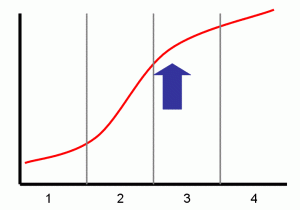
Signs the boom is entering the 3rd quarter

3rd-quater-graph

The tech industry cycles very predictably, and somehow it always feels as if it’s for the first time.  Very refreshing in a way.  Eating lunch at the picnic table in the office, we were talking about what would be some signs that the tech boom is getting into the 3rd quarter…

1) high number of new G.P.’s being hired at VC firms, just in time for their investments to crater in 3 years.
2) more people with British accents around Silicon Valley
3) increasingly attractive people, both men and women, around Silicon Valley
4) VC’s you’ve never heard of, backing companies you think, eh? What the hell is that?
5) new HBS grads joining startups
6) guys in their late 20’s breaking up with their girlfriends rather than getting married and getting distracted from work
7) married couples delaying having babies so they can focus on work
8) pretty large and pretty swanky company parties
9) oversized marketing departments
10) PR companies growing
11)  decoupling of earnings from valuations (e.g. Aqantive, You Tube)

Another thought we had was that if a viable business model emerges for YouTube, justifying the acquisition cost and calming the IP lawsuits, the boom might extend because the markets might assume it means that the ad dollars from TV will continue to migrate online, and perhaps subsequently, the online companies could inherit the viewership from the TV companies, NBC, ABC, etc.  If a good business model cannot be found for YouTube… then maybe the party in our little corner of the IT world will end more or less on schedule in 18-24 months.

Standard
Ooga Labs

RailsConf 2007 summary

So a couple of us engineers and our CEO went up to Portland, OR for RailsConf 2007. Overall, it was a good conference and the whole list of “Who’s Who?” was there. We attended many sessions, but I liked JRuby and Solr the most.

RailsConf 2007 had over 1600 in attendance, so its pretty clear that the Ruby/Rails community is growing leaps and bounds. This is great news for us as we’re big proponents of the Rails platform.  All of the energy and community behind Rails offers a lot of credence to the platform, and this was very evident with all of the many interesting sessions at RailsConf.

It was also clear that the number of Rails jobs is growing faster than the number of available engineers. In the foyer of the conference was a big message board and there was easily a ratio of 25:1 the number of “we’re hiring” to “looking for work” posts.   We are  looking to hire developers too, and we will teach you Rails and Ruby if you’re a great programmer in another language.

But onto the cool stuff! Adobe Apollo, and to a lesser degree Flex, was a common topic. Its very clear that the Adobe Flex/Flash platform is going to be a major player. Some engineers from Adobe did a session and showed how easy it is to connect an Apollo app to a Rails backend. Super cool!

We went to so many sessions that they are all blurring together. Here is a link to all of the RailsConf 2007 presentations.

Standard
Analysis, Cool companies

Twitter, a great investment for someone

Twitter has tapped a new pleasure center in the human brain at the intersection of cell phones and the Web.  That’s a big deal, I think.  Instant Messaging was an interface that tapped a new pleasure center in the human brain when all the computers got connected.  Social networking was an interface that tapped a new pleasure center in the human brain when digital photography hit.  Now it’s happening again, perhaps.  Twitter is first with the application, growing fast, and they NAILED the name, which can be a brand and a verb.  Investors get in if you can.

Standard
Ooga Labs

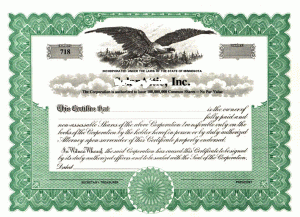
Starter Stock

stock-certificate-for-starter-stock

We’re starting several companies simultaneously at Ooga Labs, and we are trying to be careful and creative about the financial and corporate structures we’re putting in place. It can end up mattering a lot in terms of how much value you can create and capture over the life of an enterprise. My last company, Tickle, founded in 1999, was a Delaware C-Corp, which is the most familiar structure to the VC community, and some of the Ooga Labs companies are also C-Corps.

The C-Corp structure served Tickle well until 2004, when we were trying to do a $20 million round of financing with new VC investors. It made no sense for the company Starters (which we define as the founders as well as early employees) who were still renting apartments, driving old Toyota Corolla’s and starting to have children, to keep going without taking some money off the table. The traditional equity structure prevented it from being easy without raising the strike price of the common shares. As is typical in most C-Corp’s, the Starters held common while the VC’s held the preferred, senior shares. The main reason a Board wants to keep the common share price down is because it’s hard to hire sophisticated new employees (including existing management’s replacements, potentially) when the strike price of the options in their equity package is high. The Board fears really good people will do the math and see they have far less upside for coming to your start up vs another start up with a lower strike price. It’s a point VC’s will often not relent on, certainly ours wouldn’t.

So we embarked on trying to figure out how to get the Starters some liquidity without killing the common share price. We spent 3 months and $350K of money with three prominent Silicon Valley law firms (one for us, one for our existing VC investors, and one for the new lead VC investor) to try to figure out how to make it work. What we found was that the ways of accomplishing our goal that had been acceptable to the IRS and SEC around 1999, had been eliminated by Sarbanes-Oxley by 2004. So we had to explore other back flips like re-capitalizing the company. In the end, we bailed on the financing for other reasons, but I had learned my lesson about the need for some sort of special stock for the Starters. I had also learned a lot more about how the SEC and IRS think about things, and we had come up with an idea for a new type of stock that would alleviate all the machinations to get Starters some liquidity along the path of growing their company. I vowed that when we started my next companies, we would fix this problem by implementing from the beginning, this separate kind of Starter Stock, which would represent some minority portion of the stock that each of the Starters received.

The basic idea of Starter Stock is that it 1) confers special voting rights to those who get the stock, and 2) it can be converted to any preferred equity stock at the time of a financing so it can be sold at that time without raising the strike price of the common stock. For instance, if the company is considering doing a $9 million Series B preferred round with a traditional venture capital firm, the Starters would first have to approve the deal due to their special voting rights, and second, Starters could sell some – say $1 million — of their Starter Stock as Series B stock bringing the total round to $10 million. $9 million goes to the company and $1 million to buy baby some new shoes. Whether this happens or not will be up to a negotiation among the investors, the board, and all the Starters, but at least you have the opportunity to legally and simply take some money off the table which then gives you the continued confidence to go for the big hit, which, in turn, aligns you more with the investors.

Every new C-Corp. at Ooga will have a Starter Stock class. We encourage everyone starting a company to look at this option if you are going to do a C-Corporation and you are planning on raising money. Two law firms that understand this new class of stock are Orrick and Perkins Coie and you should call them if you want to go this way.

Standard
Analysis

Google should buy Facebook at any cost

Simplifying greatly, we might say the first wave of the Internet was search.  The one we’re in the middle of now is social networking (it comes in many forms: myspace, orkut, msn spaces, facebook, secondlife, yelp).  To me right now, Facebook looks like the clear winner of this phase.  First, every metric of their traffic and usage is formidable.  Second, they are truly excellent with their product.  I haven’t seen them make a significant product or strategic mistake in the last 2 years, as they have been inexorably migrating from their college market to a much broader market appeal. (some say they should stick to their college knitting, but I personally think their aims for world domination are a much better path.)  I think Yahoo made a big mistake not to offer Facebook whatever they wanted last summer. 

Their growth since Sept 06 shows they jumped to the mainstream, and there’s no looking back now.  Facebook has an open field.  They are the only social network that got big while keeping their interface clean, and the name/brand is universally appealing.  Their product reflects the understanding that they need to be a utility, just like Microsoft and Google, (I mean, look at Facebook’s new design and UI, including  their crappy little Microsoft icons and Microsoft pull down menus.  They’re emulating MS whether they know it consciously or not).  Once they get the interface which gets their people to search from Facebook instead of going to Google, they’ll be able to cut a deal with Google and capture the bulk of the value, say 80% of the revenue.

So what’s interesting about this social networking wave is that like the operating system wave of the 1980’s, there is an inherent, real network effect to the business.  That’s not true of Google.  They have a network effect in the number of advertisers bidding on their keywords, which makes them more profitable per query than #2 Yahoo, but that effect doesn’t translate into greater defensibility due to a fundamental network effect for Google users.  What Google has is a brand effect.  Very powerful, indeed.  But not a true “I get more out of using them because everyone else is using them.”  Facebook could achieve that true network effect in the next 24 months.

Further, like Microsoft was able to get into applications in the 1980’s with Word, Excel, PowerPoint, Outlook, Exchange, etc.,  Facebook can add a large number of social apps on top of their platform.  Classifieds, Music, search, digital goods, virtual worlds, currencies.  As Michael Birch of Bebo said a few months ago, “I think the next big thing is still social networking because it can morph into whatever is next.”  Very true.  And Facebook can do just that, just as Microsoft did.

If I were Yahoo, I would want to buy Facebook to stay relevant.  If I were Microsoft, I’d want to buy them so I can stay relevant and have another shot at the network effect operating system business.  If I were Google, I’d want to buy them for both those reasons, and also because I’d want to keep Microsoft from getting back in the ring.  But if I’m Facebook I’d want to stay independent, so I could build the next empire and maybe bring new ideas to how to make a difference in the world through technology.  Here’s hoping they stay independent.

Standard